
Google New Model Launch: Architecting Autonomous AI Agents with Gemini 4 Argon & Gemma 3
Google's October 2026 launch of **Gemini 4 Argon** introduces an elite frontier reasoning architecture with enhanced cybersecurity safeguards and deep analytical synthesis. This technical implementation guide shows how to architect production-grade autonomous coding agents in TypeScript using Smoke Monkey Harness, combining Gemini 4 Argon's advanced reasoning with 24 native engineering tools, local Gemma 3 offline fallback, and zero cloud vendor lock-in.
Google New Model Launch: Architecting Autonomous AI Agents with Gemini 4 Argon & Gemma 3: Google's October 2026 launch of **Gemini 4 Argon** introduces an elite frontier reasoning architecture with enhanced cybersecurity safeguards and deep analytical synthesis. This technical implementation guide shows how to architect production-grade autonomous coding agents in TypeScript using Smoke Monkey Harness, combining Gemini 4 Argon's advanced reasoning with 24 native engineering tools, local Gemma 3 offline fallback, and zero cloud vendor lock-in. Designed as a zero-dependency, open-source TypeScript architecture under the MIT License with native Model Context Protocol (MCP) support and deterministic phase state machines.
- Gemini 4 Argon Architecture: Master Google's newest frontier reasoning model with native tool execution, streaming, and subcontext memory management.
- Sovereign Multi-Model Runtimes: Eliminate cloud lock-in by pairing Gemini 4 Argon with Anthropic Claude 3.7, OpenAI o3, and local Ollama models.
- Local Gemma 3 & DeepSeek Fallback: Maintain 100% uptime with automated zero-cost offline fallbacks when cloud API limits or restrictions occur.
- 24 Native Developer Tools: Equip Gemini 4 Argon with surgical AST chunk editing, bash command execution, and automated test verification.
import { createAgent } from 'smoke-monkey-harness';// Initialize an autonomous agent with Google's new Gemini 4 Argon reasoning modelconst agent = createAgent({provider: 'gemini',model: 'gemini-4-argon',workspacePath: process.cwd(),permissions: {run_command: 'ask', // Prompt before shell commandswrite_file: 'allow', // Allow surgical AST edits},fallback: {provider: 'ollama',model: 'gemma-3:8b', // Offline local fallback},});// Execute self-healing developer workflowconst result = await agent.run('Audit repository dependencies, repair CVE vulnerabilities, and verify test suite');console.log('Result status:', result.status);
Deconstructing the Gemini 4 Argon Launch: Frontier Reasoning Meets Agentic AI
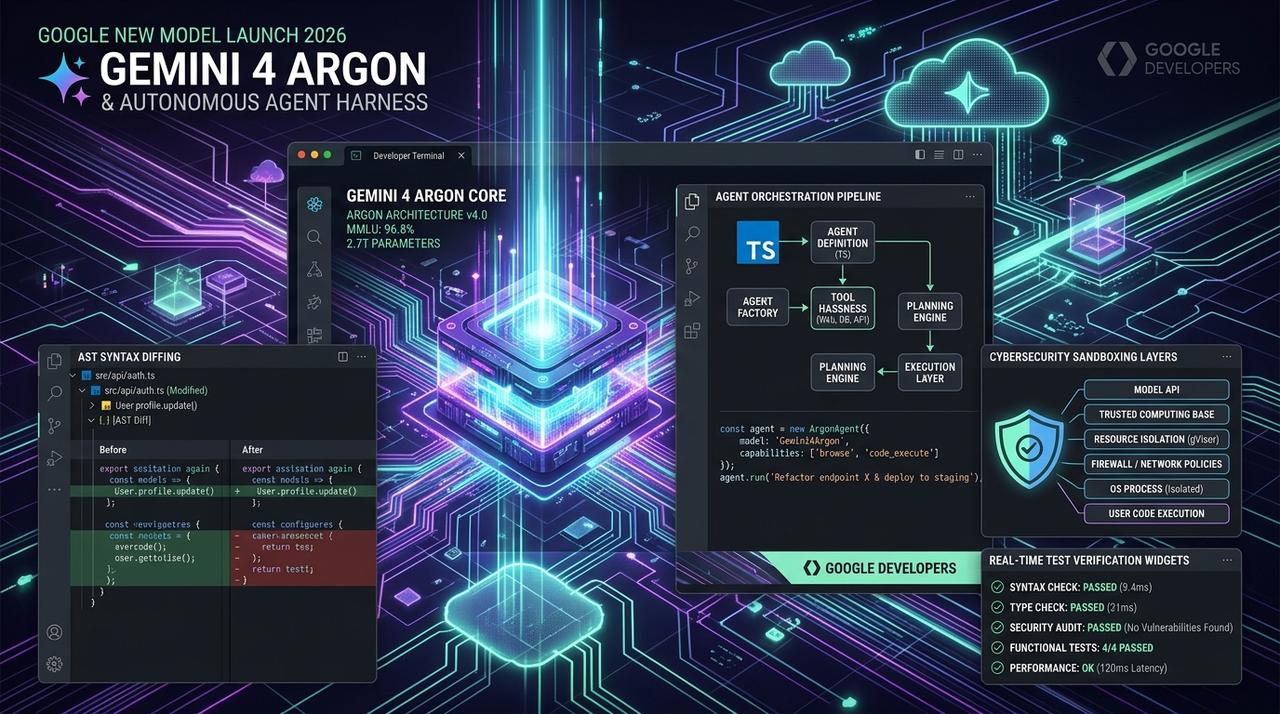
Google New Model Launch 2026: Gemini 4 Argon & Autonomous Agent Harness Architecture
Released in October 2026, Gemini 4 Argon is Google's most capable reasoning model to date. Specifically designed for high-complexity engineering domains, Argon features deep analytical planning, advanced symbolic reasoning, and rigorous cybersecurity scrutiny. In benchmarking evaluations, Argon excels at diagnosing subtle concurrency defects, parsing complex architectural dependency graphs, and synthesizing secure code modifications across multi-thousand-line repositories.
Selective Access & Cybersecurity Safeguards
Due to Argon's advanced reasoning and automated exploit analysis capabilities, Google has implemented staged access controls. Smoke Monkey Harness allows teams to seamlessly integrate Argon where available while automatically routing tasks to alternative models when needed.
Why Cloud SDKs Limit Agent Autonomy: Moving Beyond Vertex AI
While Google Cloud Vertex AI provides a hosted environment, its SDKs are designed primarily for request-response chat applications rather than autonomous agentic workflows. Developers attempting to build agents directly with raw Google APIs face significant hurdles: lack of deterministic loop management, no built-in AST code editing capabilities, tedious manual tool calling schemas, and severe cloud vendor lock-in. Smoke Monkey Harness decouples model intelligence from platform plumbing, giving you a sovereign TypeScript runtime that treats Gemini 4 Argon as a pluggable reasoning engine while managing tools, state, and permissions locally.
Configuring Gemini 4 Argon with Local Gemma 3 Fallback in Smoke Monkey
In production engineering environments, API rate limits, network interruptions, or transient cloud outages can disrupt autonomous workflows. Smoke Monkey Harness includes native multi-provider fallback. By pairing cloud-hosted Gemini 4 Argon with local Gemma 3 or DeepSeek R1 running in Ollama, your agents can continue executing offline file edits, git inspections, and compiler diagnostics without interruption.
import { createAgent } from 'smoke-monkey-harness';export const devAgent = createAgent({provider: 'gemini',model: 'gemini-4-argon',apiKey: process.env.GEMINI_API_KEY,fallback: {provider: 'ollama',model: 'gemma-3:8b', // Free local open weights},maxIterations: 30,workspacePath: process.cwd(),});
Empowering Google Models with 24 Native Engineering Tools
A model is only as effective as the tools it can operate. Smoke Monkey Harness provides Gemini 4 Argon with 24 built-in developer tools categorized into file discovery, AST chunk editing, shell command execution, git operations, and human permission requests. Rather than regenerating entire files—which wastes tokens and introduces syntax errors—the agent uses AST chunk replacements to surgically modify only the affected functions.
Frequently Asked Questions
Q:Which Google models are supported in Smoke Monkey Harness?
Smoke Monkey Harness supports all current Google Gemini models (Gemini 4 Argon, Gemini 2.5 Flash, Gemini 2.5 Pro, Gemini 2.0 Flash) via API keys, as well as open-weights Gemma 2 and Gemma 3 models via local Ollama.
Q:Do I need a Google Cloud Vertex AI account to use Gemini 4 Argon?
No! You can use standard Google AI Studio API credentials (GEMINI_API_KEY) with zero Google Cloud project configuration or complex GCP IAM roles required.
Q:How does Smoke Monkey Harness prevent runaway agent loops?
Smoke Monkey enforces maxIterations limits, token compaction thresholds, and deterministic state transitions (Explore → Plan → Edit → Verify → Recover). If an agent fails to make progress after 3 attempts, it triggers the Recover phase to ask for human guidance.
Q:Can I expose my Gemini agent as an MCP server to Cursor or Claude Code?
Yes! Smoke Monkey Harness includes a built-in Model Context Protocol (MCP) server. You can run `npx smoke-monkey-harness-mcp` to expose your Gemini agent and local tools directly to Cursor, Claude Code, or Windsurf.
Related Alternatives & Comparisons
Build with Smoke Monkey Harness
Zero dependencies. 24 built-in tools. Human-in-the-loop safety. 100% open source under the MIT License.